Healing Beyond the Badge: Overcoming Institutional Betrayal in Public Safety
When a first responder steps into danger on the street, they rely on a psychological contract: I have the department's back, and the department has mine. But when an agency breaks that trust whether through administrative betrayal, cover-ups, moral injury, or lack of support during a crisis the impact isn't just frustrating. It is deeply traumatic.
Organizational betrayal, also known as institutional betrayal, cuts directly to the core of a first responder's identity, values, and sense of safety. Understanding how it affects your brain and how to heal is the first step toward reclaiming your life.
The Neurobiology of Institutional Betrayal
When an institution you dedicated your life to fails you, your brain registers it as a severe threat. Neurobiologically, institutional betrayal triggers a high-stress state:
Amygdala Hyper-Reactivity: The brain's threat center remains stuck on high alert, causing constant hyper-vigilance, anxiety, and an inability to unwind off duty.
Prefrontal Cortex Suppression: Chronic stress weakens the brain's center for logic, emotional regulation, and critical decision-making.
Disconnected Neural Networks: Traumatic memories become "stuck" in raw, unprocessed forms, triggering intense emotional reactions whenever work issues arise.
This isn't a sign of weakness; it is a physiological response to moral injury and shattered trust.
How EMDR for First Responders Rewires the Trauma Response

To recover from institutional trauma, talking about it is rarely enough. The nervous system needs targeted processing.
Eye Movement Desensitization and Reprocessing (EMDR) utilizes bilateral stimulation such as guided eye movements or tactile taps to help the brain process stuck traumatic memories.
During EMDR, the brain shifts from a Trauma-Dysregulated State (where the amygdala dominates) to Adaptive Information Processing. This allows your prefrontal cortex to integrate the memory, effectively removing the painful emotional "sting." You won't forget what happened, but it will no longer trigger a fight-or-flight reaction every time you step into the station or think about leadership.
Reclaiming Peace: Forgiveness vs. Trust

One of the biggest hurdles in healing is misunderstanding what forgiveness actually means in an organizational context:
Forgiveness is for you, not the agency: Forgiveness simply means releasing the emotional weight that is exhausting your nervous system.
Forgiveness is not always reconciliation: You can forgive an institution without trusting them, excusing their actions, or remaining in the department.
Stop waiting for an official apology: Bureaucratic organizations rarely admit faults due to legal liability. Waiting for an institutional apology keeps your emotional well-being hostage to factors outside your control.
Practical Steps for Rebuilding Trust After Betrayal
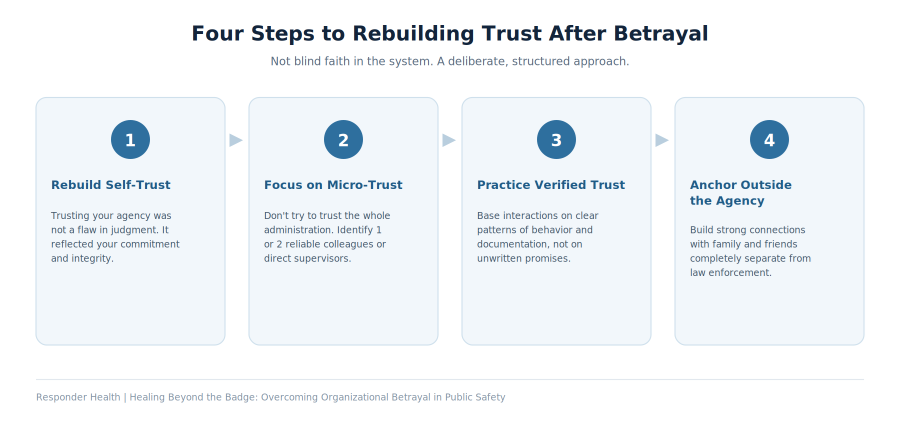
Rebuilding trust after betrayal isn't about blindly placing faith back into a system. It requires a deliberate, structured approach:
Rebuild Self-Trust: Recognize that trusting your agency was not a flaw in your intelligence; it was a reflection of your commitment and integrity.
Focus on Micro-Trust: Don't try to trust the whole administration. Identify 1 or 2 reliable colleagues or direct supervisors and build small, verified boundaries with them.
Practice Verified Trust: Base your professional interactions on clear patterns of behavior and documentation rather than unwritten promises.
Anchor Outside the Agency: Build strong connections with family, friends, and support networks completely separate from law enforcement.
Rebuilding Purpose Beyond the Badge
Your career is what you do, not who you are. Rebuilding resilience and purpose after an organizational failure involves decoupling your self-worth from your badge or rank.
Start by defining your personal values such as family, integrity, service, or personal mastery independent of the department. Focus on micro-purposes: small daily wins like mentoring a younger officer, being fully present at home, or developing a new personal skill.
Moving Forward
Organizational betrayal is painful, but it does not have to define the rest of your life or career. By combining trauma-informed therapies like EMDR for first responders, setting hard professional boundaries, and anchoring your identity outside the job, you can heal your nervous system and reclaim a profound sense of peace and purpose.
Sources
Kredlow, M.A., Fenster, R.J., Laurent, E.S., et al. (2022). Prefrontal cortex, amygdala, and threat processing: implications for PTSD. Neuropsychopharmacology.
U.S. Department of Veterans Affairs, National Center for PTSD. Moral Injury.
Freyd, J.J. Institutional Betrayal Research. University of Oregon.
Smith, C.P., & Freyd, J.J. (2014). Institutional Betrayal. American Psychologist.
Rydberg, J.A., Virgitti, L., & Tarquinio, C. (2024). Bolstering the Adaptive Information Processing Model: A Narrative Review. Frontiers in Psychiatry.
U.S. Department of Veterans Affairs & Department of Defense (2023). Clinical Practice Guideline for the Management of PTSD and Acute Stress Disorder.
Mayo Clinic. Forgiveness: Letting go of grudges and bitterness.
About Responder Health
Responder Health is a first responder health and wellness program dedicated to law enforcement mental health and the behavioral wellness of firefighters, EMS personnel, and their families. First responder family support is a core part of that mission — because no one carries this work alone. Through a peer support program, mental health resources, and a commitment to first responder wellness, Responder Health works to make sure no first responder faces their hardest moments alone. If you or someone you know is struggling — whether with grief, burnout, or the invisible weight of the job — reaching out to a mental health hotline is one of the most important steps you can take. Trained peer advocates are available around the clock. Call the Responder Health 24/7 Peer Advocate Hotline at 253-243-3701 — available 24 hours a day, 7 days a week.




Comments